You Won’t Believe These Hidden Architectural Gems in Brisbane
When I first wandered through Brisbane, I expected sun and river views—but not architectural magic hiding in plain sight. Forget the usual landmarks; this city’s true character lives in its unexpected structures: a library shaped like a paper crane, a market wrapped in steel lace, and buildings that blend nature with bold design. I was stunned by how creativity thrives in overlooked corners. This is not just urban planning—it’s art you can walk through. Let me take you where most tourists never look.
Beyond the Skyline: Brisbane’s Secret Architectural Soul
Brisbane is often celebrated for its laid-back riverside lifestyle, golden subtropical light, and green hills that roll into the horizon. Yet beneath this postcard-perfect surface lies a quieter, more thoughtful revolution—one shaped in steel, timber, and sunlight. While the city’s skyline features modern towers, its true architectural soul reveals itself in subtle, human-centered designs that prioritize harmony over height. These are not monuments to ego, but invitations to experience space differently—where form follows both function and feeling.
What sets Brisbane apart is its design philosophy: an intentional blend of sustainability, cultural awareness, and aesthetic courage. Architects here respond to the region’s humid climate, intense sun, and rich natural surroundings by creating spaces that breathe, adapt, and invite interaction. Green roofs, passive cooling, and open-air layouts are not afterthoughts—they are foundational. This is architecture that listens: to the land, to the people, and to the legacy of place. As a result, many of the city’s most compelling structures are not the tallest, but the most thoughtful.
These hidden gems reflect a broader shift in Queensland’s cultural identity. No longer content to imitate global trends, Brisbane has cultivated a design language all its own—one that respects Indigenous heritage, embraces ecological responsibility, and celebrates local craftsmanship. From adaptive reuse projects to innovative public spaces, the city’s architecture tells a story of quiet confidence. It doesn’t shout; it whispers. And if you slow down, you’ll hear it.
The City Botanic Gardens’ Whispering Canopy Walk
Nestled along the bends of the Brisbane River, the City Botanic Gardens offer more than just floral serenity—they cradle one of the city’s most poetic architectural interventions: the elevated Canopy Walk. This slender, winding pathway floats among the treetops, threading through centuries-old figs and weeping lilly pillies like a ribbon of light and shadow. It is not merely a walkway but a sensory experience, designed to shift perspective—literally and metaphorically—by lifting visitors into the realm of birds and breeze.
The design is a masterclass in ecological sensitivity. Built primarily from reclaimed timber and recycled steel, the structure minimizes its footprint while maximizing connection. Engineers worked closely with botanists to ensure no major roots were disturbed, and the supports are anchored in a way that allows trees to grow naturally around them. The handrails are low and unobtrusive, encouraging people to look outward and upward, not down at their feet. At dawn, when mist clings to the leaves and the first light filters through the canopy, the walk feels almost sacred—an urban sanctuary where nature and design coexist in quiet dialogue.
What makes the Canopy Walk truly special is its ability to transform the familiar into the extraordinary. Locals who have passed through the gardens for years suddenly see them anew—branches become architecture, leaves become stained glass, and the city’s hum fades into a distant lullaby. Children laugh as they spot lorikeets; seniors pause to rest on curved benches that echo the shapes of tree trunks. This is architecture that doesn’t dominate the landscape but disappears into it—only to reappear as something more meaningful.
State Library of Queensland: Where Light Dances on Concrete
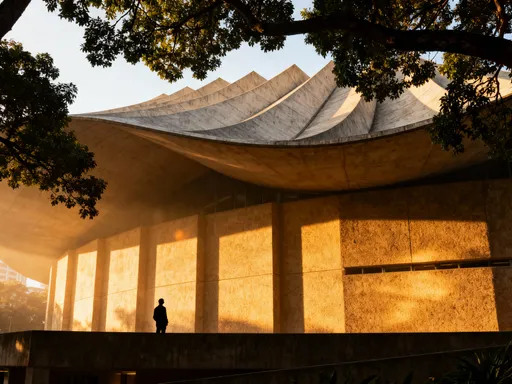
If Brisbane has a temple of ideas, it is the State Library of Queensland. Located within the South Bank Cultural Precinct, this building defies the stereotype of the hushed, book-lined fortress. Instead, it opens itself to the sky, the river, and the people. Its most striking feature is the sweeping, curved roof that flows like a folded sheet of paper caught mid-motion—a nod to the act of reading, writing, and the unfolding of knowledge. Designed by Donovan Hill and Peddle Thorp, the library is a landmark of contemporary Australian architecture, celebrated for its elegance and environmental intelligence.
Natural light is not just welcomed here; it is choreographed. The roof’s design creates deep overhangs that shade the interior during the harsh midday sun, while allowing lower-angle morning and afternoon light to spill across polished concrete floors. Vertical brise-soleil—sun-shading fins—line the façade, their spacing calibrated to Brisbane’s latitude and sun path. Inside, the air moves freely through open-plan spaces, supported by a passive ventilation system that reduces reliance on artificial cooling. The result is a building that feels alive, responsive, and deeply attuned to its subtropical setting.
But beyond its technical brilliance, the library thrives as a social heart. Families gather in the children’s corner under a suspended sculpture of floating books; students study beneath soaring eaves where light shifts like water; elders browse local history archives in quiet alcoves. Outdoor terraces host impromptu performances, while digital labs invite creativity. This is not just a place to borrow books—it is a living forum where culture, technology, and community intersect. The architecture supports all of it, proving that beauty and utility need not be mutually exclusive.
South Bank’s Wheel of Brisbane and the Steel Lace Pavilion
South Bank is Brisbane’s vibrant cultural playground, and its architecture plays a starring role in the experience. Among the most photographed features is the Wheel of Brisbane, a 60-meter-tall observation wheel that offers panoramic views of the river and skyline. But its real architectural intrigue lies not in its height, but in its minimalist support structure—a delicate lattice of steel that appears almost weightless. At night, when illuminated in rotating colors, it becomes a beacon of joy, a kinetic sculpture that invites both riders and onlookers into a moment of wonder.
Just steps away stands the Steel Lace Pavilion, a permanent structure that embodies the artistry of functional design. Its ceiling is a mesmerizing pattern of laser-cut metal, inspired by traditional lacework but reimagined with modern precision. As sunlight passes through, it casts intricate shadows on the ground—constantly shifting with the time of day. These patterns create natural shade for visitors below, transforming a simple resting area into a dynamic, ever-changing gallery of light and form.
Together, these structures exemplify how temporary and permanent installations can enhance urban life without overwhelming it. The Ferris wheel, though temporary in concept, has become a beloved fixture, while the pavilion serves as a quiet counterpoint—a place to sit, reflect, and watch the world move. Both prioritize human experience: flow, comfort, beauty. They are not just decorative; they are integral to the precinct’s rhythm, guiding movement, offering respite, and creating moments of surprise. In a city that values livability, such details matter deeply.
Turrbal and Jagera Inspirations in Modern Design
Brisbane’s architectural evolution is increasingly shaped by a deeper respect for its First Nations heritage. The Turrbal and Jagera peoples, the Traditional Custodians of the land, are finding their stories echoed in the curves, materials, and meanings embedded in new buildings. This is not tokenism, but a growing commitment to authentic collaboration—where design becomes a vessel for cultural continuity and recognition.
One powerful example is the Aboriginal and Torres Strait Islander Cultural Centre at South Bank. Its architecture speaks in soft, flowing lines that mirror the movement of water and wind across the landscape. Earth-toned materials—sandstone, timber, and oxidized steel—anchor it to the region’s natural palette. The entrance is oriented to follow ancestral pathways, and interpretive elements are woven into the structure itself, not tacked on as afterthoughts. Here, architecture does not merely house culture—it becomes a form of storytelling.
Other projects across the city are following suit. Public plazas now incorporate Turrbal naming and storytelling markers. New civic buildings consult with Elders during the design phase, ensuring that symbolism, orientation, and materials reflect local significance. Even stormwater drains are being reimagined as artful channels that reference Dreaming stories of rivers and rain. These choices are not just aesthetic—they are acts of reconnection, acknowledging that place is not just physical, but deeply spiritual. For visitors, this adds a layer of meaning to every step: you are not just walking through a city, but across living history.
The Powerhouse Transformation: From Power Station to Creative Hub
On the banks of the Brisbane River in New Farm stands a building that pulses with creative energy—the Brisbane Powerhouse. Once a functioning power station that lit the city in the early 20th century, it has been reborn as one of Australia’s most dynamic multi-arts venues. The transformation is a triumph of adaptive reuse, where industrial grit meets artistic vision. Exposed brick walls, steel beams, and original turbine halls remain, not as relics, but as character-rich backdrops for theater, dance, visual art, and live music.
The renovation, completed in 2000 and continually refined since, respected the building’s heritage while reimagining its purpose. Large industrial windows now frame river views; old control rooms have become intimate performance spaces; and the exterior retains its bold, utilitarian form, softened only by climbing bougainvillea and evening lighting that highlights its muscular silhouette. The architects resisted the urge to over-polish, understanding that authenticity often lies in imperfection—the rust on a pipe, the unevenness of aged concrete, the echo of footsteps in a vast hall.
By night, the Powerhouse truly comes alive. During festivals like Brisbane Festival or Wonderland, the grounds buzz with food stalls, fire dancers, and crowds spilling onto the lawns. Light installations glow through old ventilation shafts; music spills from converted engine rooms. Yet even on quiet afternoons, the space invites exploration. A café hums in the former boiler room; artists sketch in sunlit courtyards; couples sip coffee under shade sails strung between chimneys. This is architecture with memory—a place that honors its past while embracing a vibrant, unpredictable future.
Finding the Unseen: How to Explore Brisbane’s Architectural Secrets
Discovering Brisbane’s hidden architectural treasures doesn’t require a degree in design—just curiosity and a willingness to look beyond the obvious. The best way to begin is on foot, starting in the Cultural Precinct along South Bank, where the density of thoughtful design is highest. Begin at the Queensland Performing Arts Centre, with its wave-like façade, then drift toward the Gallery of Modern Art, whose bold geometric forms contrast beautifully with the river’s soft curves.
From there, follow the Riverwalk toward Kangaroo Point, where cliffs meet modern apartments designed to maximize cross-ventilation and views. Notice how balconies are angled to catch breezes, and how communal spaces are shaded by deep overhangs. Along the way, pause at the Story Bridge’s southern end, where a small park features seating sculpted from recycled materials—each piece echoing the bridge’s steel trusses.
For a more structured exploration, pick up a free architecture map from the Brisbane Visitor Information Centre or download the Brisbane Open House app, which highlights self-guided walking routes. Better yet, join a guided tour during Brisbane Open House weekend, when normally closed buildings—from private lofts to engineering hubs—open their doors. Local architects and historians lead these walks, offering insights you’d never spot alone.
Timing is everything. Visit at golden hour—just after sunrise or before sunset—when light transforms materials. Watch how the State Library’s textured walls glow amber, or how the Steel Lace Pavilion’s shadows stretch and blur. Look up frequently: Brisbane’s magic often lies above eye level. And don’t rush. Some of the most memorable discoveries happen when you pause—a hidden mural on a service door, a courtyard blooming behind a glass façade, the sound of wind through a sculptural vent. The city reveals itself slowly, to those who are paying attention.
Encourage children to join the adventure with a simple game: “Find the shape that mimics nature” or “Spot the recycled material.” Not only does this deepen engagement, but it fosters a lifelong appreciation for sustainable design. Bring a notebook or camera, but also allow moments of quiet observation. Architecture is not just to be seen—it is to be felt, remembered, and carried forward.
Brisbane’s architecture isn’t about towering skyscrapers—it’s about thoughtful, human-scale design that surprises and delights. These hidden structures reveal a city confident in its identity, blending innovation with respect for land and culture. By seeking them out, travelers don’t just see Brisbane—they feel it. The real journey begins when you stop looking at maps and start seeing the stories written in steel, light, and shadow.